
The Echo of Chile and a Dialogue with the World
In this site we have previously mentioned that music and storytelling could be an avenue for understanding and acceptance. They also encourage denunciation of the human depravity which seeks to impose itself in this transitional period. This musical piece by Paul McCartney and an arrangement by Quilapayún shows that beauty can cross universes. These universes are as distinct as those between the New Chilean Song and the English creator in the form of classical music.
Quilapayún is more than a band. They are an institution of cultural memory, one of the greatest voices of Latin America’s Nueva Canción movement, and a living example of how music can both embody national identity and transcend borders. From the streets of Santiago to exile in Paris, from peasant ballads to avant-garde collaborations, their journey spans almost six decades. And in the weave of their story, a surprising thread emerges: a resonance with The Beatles’ Paul McCartney and the baroque melancholy of Eleanor Rigby.
Roots of a Movement
Founded in 1965, Quilapayún took their name from Mapudungun, the Mapuche Indigenous language, roughly meaning “three beards.” Under the artistic direction of Víctor Jara, the group quickly aligned itself with Chile’s social and political awakening. Their repertoire merged Andean folk instruments—the quena (flute), zampoña (panpipes), and charango (small lute)—with classical guitar and choral arrangements.
They were part of Nueva Canción Chilena, a movement not merely about style but about message. It aimed to give voice to workers, campesinos, and the oppressed. Songs such as “La Muralla” called for collective defense against tyranny. Meanwhile, “El Pueblo Unido Jamás Será Vencido” became one of the most powerful protest anthems of the 20th century.
The European Classical Avant-Gardge
Exile in France brought Quilapayún into direct contact with European composers experimenting with orchestral forms. Their collaborations with Luis Advis, a Chilean composer trained in both classical and popular traditions, already blurred boundaries. Advis’ cantatas placed Quilapayún within the lineage of Bach’s Passions and Stravinsky’s narrative works.
Quilapayún also recorded with full symphony orchestras, experimenting with tonal colors that paralleled the avant-garde explorations of the 1970s—though always grounded in political narrative. While Stockhausen and Boulez sought abstraction, Quilapayún used similar tools to cement history and memory, giving the avant-garde a human face.
The North American Protest Folk
Across the Atlantic, Bob Dylan, Joan Baez, and Pete Seeger were also wielding music as social commentary. Yet while North American folk tended toward individual voices with guitar, Quilapayún offered a collective choral sound.
This difference is striking: Dylan’s “Blowin’ in the Wind” asks questions in a singular, poetic voice; Quilapayún’s “La Muralla” builds a wall of voices, literally embodying collective defense. Both traditions, however, demonstrate how folk idioms could articulate dissent in the 1960s global wave of civil rights, anti-war movements, and decolonization.
The Political Stage
By the early 1970s, Quilapayún had become the cultural ambassadors of Salvador Allende’s Unidad Popular government. Their concerts were as much political gatherings as musical performances. The military coup of 1973 shattered this world. It forced the group into exile in France. Yet exile expanded their audience. Europe discovered Chile through their voices, and their albums carried the memory of repression to listeners worldwide.
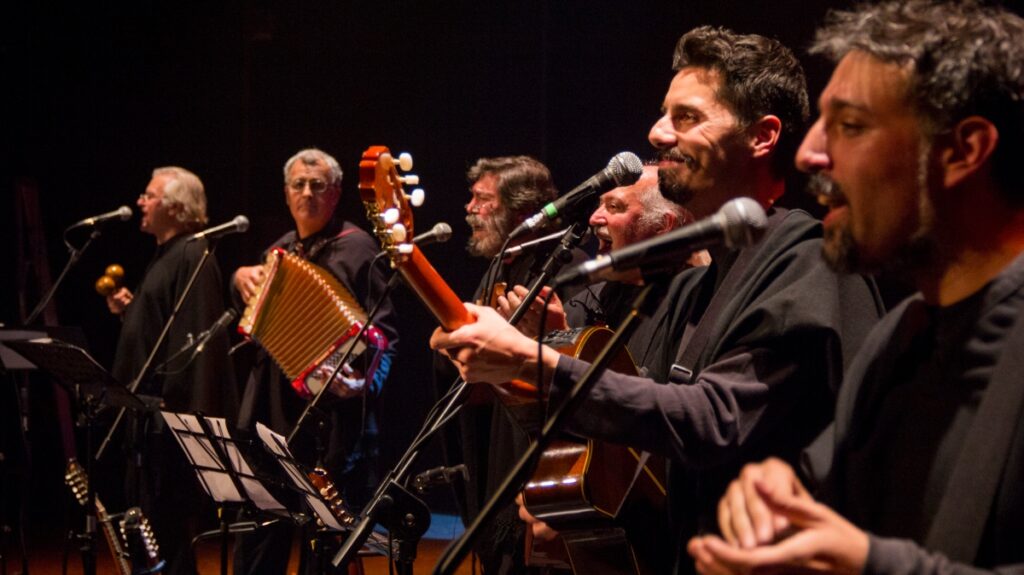
In France, they deepened their repertoire, collaborating with orchestras, experimenting with classical forms, and engaging with intellectual circles. This openness to global influences created fertile ground for an unexpected confluence with Western pop traditions.
Enter Paul McCartney and Eleanor Rigby
At first glance, Quilapayún and The Beatles seem to inhabit different universes: one a politically charged collective rooted in folk traditions, the other the most famous rock band of all time. Yet, a closer listen reveals striking intersections—especially with Paul McCartney’s composition Eleanor Rigby (1966).
Eleanor Rigby is often cited as The Beatles’ first leap into a neo-classical aesthetic. It is driven entirely by a string octet arranged by George Martin, with no guitars or drums. Its theme—the loneliness and anonymity of ordinary people—is timeless. It borders on liturgical in tone.
Quilapayún, from their side, were creating a body of work in the late 1960s that shared these qualities. They made choral laments, chamber-like arrangements, and socially conscious storytelling. Consider the “Cantata Santa María de Iquique” (1970), Luis Advis’s monumental work recorded by Quilapayún. Like Eleanor Rigby, it frames everyday tragedy—the 1907 massacre of striking nitrate miners—within a musical architecture. This draws from classical and folk idioms alike.
Both works elevate the ordinary and the forgotten into art that demands remembrance. McCartney’s lonely Eleanor and Father McKenzie, nameless in life, become eternal through song. Quilapayún’s workers, gunned down by soldiers, are immortalized in a cantata that blends oratorio with folk protest.
Resonances Across Borders
It is not documented that Quilapayún and McCartney directly collaborated—but musically and thematically, they were part of a shared global shift in the 1960s:
- Away from formulaic pop toward serious, socially engaged art.
- Toward using classical forms and instrumentation to tell modern stories.
- Toward empathy for the anonymous and forgotten—be they British urban poor or Chilean nitrate miners.
When Quilapayún performed in Europe during their exile, audiences steeped in The Beatles’ revolution found their music familiar yet radically different. The solemn harmonies of Eleanor Rigby prepared listeners to accept that a Latin American folk group could also stage tragedies with universal weight.
Enduring Legacy
Today, Quilapayún’s discography—over 30 albums—still resonates. Songs like “Por Qué Los Pobres No Tienen” interrogate inequality with relevance for today’s world. Meanwhile, Eleanor Rigby remains one of McCartney’s masterpieces, covered across genres and continents.
Together, these works testify to a truth about the 1960s. Music, whether born in Liverpool or Santiago, had the power to humanize the invisible and to bind art with conscience. Quilapayún and McCartney may never have shared a stage, but their art shares a kinship—a commitment to amplifying voices drowned out by indifference.
🎶 Suggested Listening & Viewing
- Quilapayún – Cantata Santa María de Iquique (full recording, 1970)
- Quilapayún – El Pueblo Unido Jamás Será Vencido
- The Beatles – Eleanor Rigby (1966)
- Compare: the use of strings in McCartney’s work and the use of choir + folk orchestra in Quilapayún
Maya Riviera Condos