
Music and poetry as a form of resistance and cultural transference has been at the forefront of artist creativity and human development. Musicians have played a vital role in the development of human societies by preserving and shaping cultural traditions through sound and rhythm. From ancient tribal chants to modern symphonies, music reflects the values, stories, and emotions of communities, providing a shared language that transcends time and geography.
Traditions passed down by musicians help maintain a connection to the past while also allowing for innovation and adaptation. This continuous interplay enriches cultural identities and fosters social cohesion. Music ceremonies, rituals, and celebrations have historically marked important milestones in human life, reinforcing communal bonds and collective memory.
As societies evolved, musicians often became storytellers, historians, and agents of change. Their art not only entertained but also educated, challenged norms, and inspired movements, illustrating music’s profound impact on societal growth and human experience. Through the interplay of tradition and creativity, musicians contribute to the ongoing narrative of human development.
Herencia pa’ un Hijo Gaucho
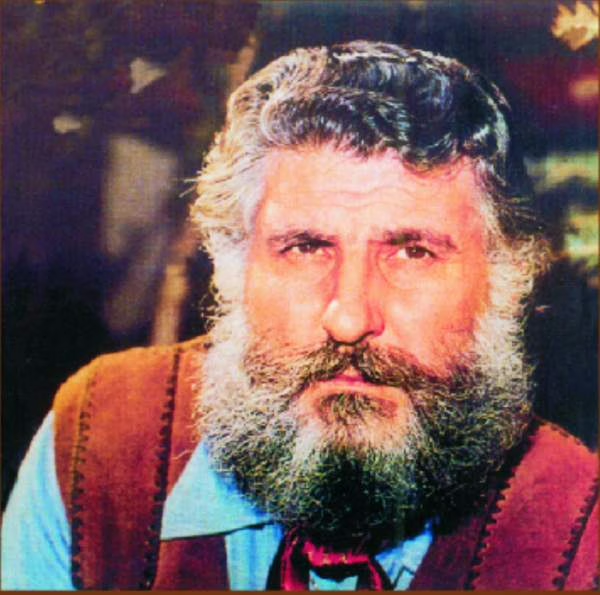
José Larralde, one of Argentina’s most respected folk singers and poets, is often described as a payador in the purest sense of the word. His songs are deeply rooted in the traditions of the Argentine pampa. They stand as testimonies of rural life, social struggle, and cultural identity. Among his most evocative compositions is “Herencia pa’ un hijo gaucho” (“Inheritance for a Gaucho Son”). This piece distills his worldview and offers insight into his broader artistic project. Through this work, Larralde not only reaffirms his commitment to gaucho traditions but also articulates the challenges, dignity, and values of rural Argentina.
Herencia pa’ un hijo gaucho — Selected Translation

(Opening testament)

“Son, I don’t leave you riches,
not even a roof or a bit of land.
My inheritance is poor,
but it’s honest, and it’s yours.”

(On dignity and poverty)

“Don’t bow your head for being poor,
because poverty isn’t shameful.
Shame is in being a coward,
or forgetting who you are.”

(Advice on work and honesty)
“Always earn your bread with your hands,
even if it’s little, even if it’s hard.
Better to live from your sweat
than from another man’s gift.”

(On justice and respect)

“Be fair, even with the rich,
but don’t let yourself be stepped on.
Respect others, son,
and demand they respect you.”

(Closing legacy)

“This is the inheritance I leave you:
my word, my blood, my example.
I have no gold to hand down—
only the truth of being a gaucho.”
The Gaucho as Symbol and Reality
In Argentine cultural history, the gaucho has long been a central figure—half-mythic, half-real—embodying independence, resilience, and connection to the land. From the epic poem Martín Fierro by José Hernández to the music of Atahualpa Yupanqui, the gaucho has served as a metaphor for the nation’s soul and its struggles against injustice. Larralde situates himself firmly within this lineage. Unlike romanticized portrayals of gauchos as carefree wanderers, his work emphasizes the social conditions, poverty, and injustices endured by rural workers. He speaks not from a folkloric distance but from lived experience. Larralde himself laboured in rural trades before turning fully to music.
“Herencia pa’ un hijo gaucho”: More Than a Legacy
In “Herencia pa’ un hijo gaucho,” Larralde presents a father’s testament to his son. However, the “inheritance” is not material wealth—it is values, dignity, and a moral code rooted in honesty and perseverance. He frames poverty not as a source of shame but as a condition that sharpens character. What the gaucho father leaves behind is not land or cattle. It is the wisdom of survival: humility before nature, solidarity with one’s peers, and resistance to exploitation.
This inversion of inheritance—away from property and toward principles—challenges modern values of materialism. Crucially, it places the weight of cultural transmission not on possessions but on ethos. For Larralde, the true legacy of the gaucho is a worldview forged in hardship. This legacy can sustain a son even when economic inheritance fails.
The Social and Political Undercurrents
Larralde’s work, though often couched in the intimate tones of fatherly advice or poetic reflection, is never far from social critique. His songs expose the precarious lives of rural workers. They address their displacement by modernization and the erosion of communal traditions. In this sense, “Herencia pa’ un hijo gaucho” is not only a personal song. It is also a collective lament. The song serves as a call to preserve cultural dignity amid social inequality.
Unlike more commercialized strands of folk music, Larralde resisted mainstream industry pressures. He seldom granted interviews, avoided self-promotion, and preferred to let his music speak for itself. This integrity resonates with the very values he espouses in his song: authenticity, humility, and loyalty to one’s roots.
Continuity with Folk Tradition
Larralde’s artistry cannot be separated from the broader Argentine folk tradition. Like Atahualpa Yupanqui, he saw music as an instrument of testimony and resistance. Yet, his style is starker, less adorned, and more direct. He often relies on his voice and guitar alone. This simplicity gives his work a raw power. It provides an oral inheritance that mirrors the very content of “Herencia pa’ un hijo gaucho.” The sparse musical backdrop ensures that the weight of the words falls squarely on the listener. It evokes the atmosphere of the payada. In this way, meaning is carried more by word than by melody.
Conclusion
“Herencia pa’ un hijo gaucho” is both a song and a philosophy of life. In it, José Larralde redefines inheritance as the transmission of values, not possessions. He asserts the dignity of those who, though poor, carry within themselves the wisdom of endurance and honesty. His broader body of work continues this project: giving voice to the voiceless, preserving the cultural memory of the gaucho, and critiquing the injustices that threaten rural communities. In doing so, Larralde affirms that the true wealth of Argentina’s countryside is not its cattle or land, but the human spirit forged under its vast skies.
Submit your review | |