Blog

  • Quilapayún

    The Echo of Chile and a Dialogue with the World

    In this site we have previously mentioned that music and storytelling could be an avenue for understanding and acceptance. They also encourage denunciation of the human depravity which seeks to impose itself in this transitional period. This musical piece by Paul McCartney and an arrangement by Quilapayún shows that beauty can cross universes. These universes are as distinct as those between the New Chilean Song and the English creator in the form of classical music.

    Quilapayún is more than a band. They are an institution of cultural memory, one of the greatest voices of Latin America’s Nueva Canción movement, and a living example of how music can both embody national identity and transcend borders. From the streets of Santiago to exile in Paris, from peasant ballads to avant-garde collaborations, their journey spans almost six decades. And in the weave of their story, a surprising thread emerges: a resonance with The Beatles’ Paul McCartney and the baroque melancholy of Eleanor Rigby.

    Live performance of Eleanor Rigby

    Roots of a Movement

    Founded in 1965, Quilapayún took their name from Mapudungun, the Mapuche Indigenous language, roughly meaning “three beards.” Under the artistic direction of Víctor Jara, the group quickly aligned itself with Chile’s social and political awakening. Their repertoire merged Andean folk instruments—the quena (flute), zampoña (panpipes), and charango (small lute)—with classical guitar and choral arrangements.

    They were part of Nueva Canción Chilena, a movement not merely about style but about message. It aimed to give voice to workers, campesinos, and the oppressed. Songs such as “La Muralla” called for collective defense against tyranny. Meanwhile, “El Pueblo Unido Jamás Será Vencido” became one of the most powerful protest anthems of the 20th century.

    The European Classical Avant-Gardge

    Exile in France brought Quilapayún into direct contact with European composers experimenting with orchestral forms. Their collaborations with Luis Advis, a Chilean composer trained in both classical and popular traditions, already blurred boundaries. Advis’ cantatas placed Quilapayún within the lineage of Bach’s Passions and Stravinsky’s narrative works.

    Quilapayún also recorded with full symphony orchestras, experimenting with tonal colors that paralleled the avant-garde explorations of the 1970s—though always grounded in political narrative. While Stockhausen and Boulez sought abstraction, Quilapayún used similar tools to cement history and memory, giving the avant-garde a human face.

    The North American Protest Folk

    Across the Atlantic, Bob Dylan, Joan Baez, and Pete Seeger were also wielding music as social commentary. Yet while North American folk tended toward individual voices with guitar, Quilapayún offered a collective choral sound.

    This difference is striking: Dylan’s “Blowin’ in the Wind” asks questions in a singular, poetic voice; Quilapayún’s “La Muralla” builds a wall of voices, literally embodying collective defense. Both traditions, however, demonstrate how folk idioms could articulate dissent in the 1960s global wave of civil rights, anti-war movements, and decolonization.


    The Political Stage

    By the early 1970s, Quilapayún had become the cultural ambassadors of Salvador Allende’s Unidad Popular government. Their concerts were as much political gatherings as musical performances. The military coup of 1973 shattered this world. It forced the group into exile in France. Yet exile expanded their audience. Europe discovered Chile through their voices, and their albums carried the memory of repression to listeners worldwide.
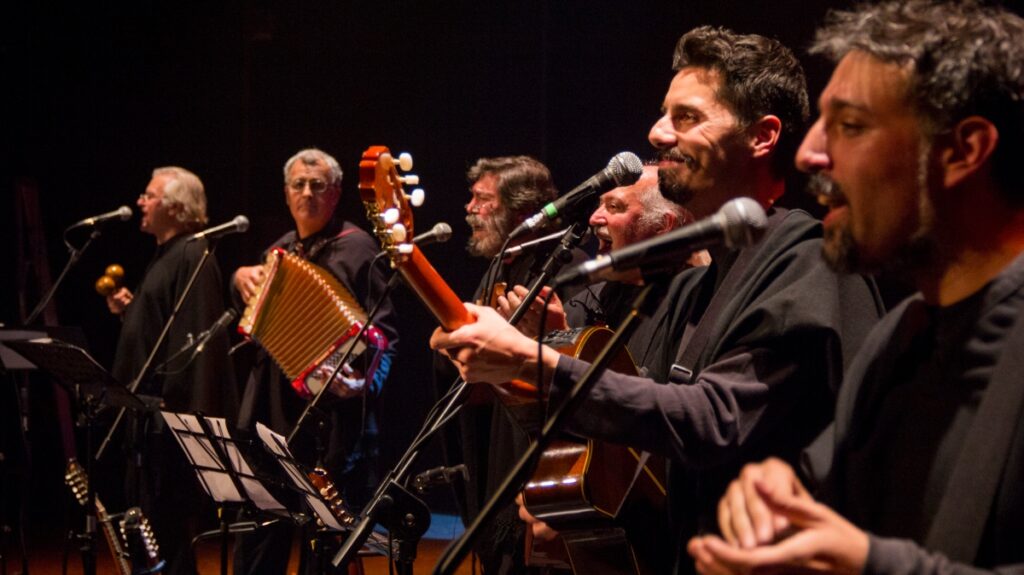
    Quilapayun in Concert in Chile.
    Quilapayún in Chile.

    In France, they deepened their repertoire, collaborating with orchestras, experimenting with classical forms, and engaging with intellectual circles. This openness to global influences created fertile ground for an unexpected confluence with Western pop traditions.


    Enter Paul McCartney and Eleanor Rigby

    At first glance, Quilapayún and The Beatles seem to inhabit different universes: one a politically charged collective rooted in folk traditions, the other the most famous rock band of all time. Yet, a closer listen reveals striking intersections—especially with Paul McCartney’s composition Eleanor Rigby (1966).

    Eleanor Rigby is often cited as The Beatles’ first leap into a neo-classical aesthetic. It is driven entirely by a string octet arranged by George Martin, with no guitars or drums. Its theme—the loneliness and anonymity of ordinary people—is timeless. It borders on liturgical in tone.

    Quilapayún, from their side, were creating a body of work in the late 1960s that shared these qualities. They made choral laments, chamber-like arrangements, and socially conscious storytelling. Consider the “Cantata Santa María de Iquique” (1970), Luis Advis’s monumental work recorded by Quilapayún. Like Eleanor Rigby, it frames everyday tragedy—the 1907 massacre of striking nitrate miners—within a musical architecture. This draws from classical and folk idioms alike.

    Both works elevate the ordinary and the forgotten into art that demands remembrance. McCartney’s lonely Eleanor and Father McKenzie, nameless in life, become eternal through song. Quilapayún’s workers, gunned down by soldiers, are immortalized in a cantata that blends oratorio with folk protest.


    Resonances Across Borders

    It is not documented that Quilapayún and McCartney directly collaborated—but musically and thematically, they were part of a shared global shift in the 1960s:

    • Away from formulaic pop toward serious, socially engaged art.
    • Toward using classical forms and instrumentation to tell modern stories.
    • Toward empathy for the anonymous and forgotten—be they British urban poor or Chilean nitrate miners.

    When Quilapayún performed in Europe during their exile, audiences steeped in The Beatles’ revolution found their music familiar yet radically different. The solemn harmonies of Eleanor Rigby prepared listeners to accept that a Latin American folk group could also stage tragedies with universal weight.


    Enduring Legacy

    Today, Quilapayún’s discography—over 30 albums—still resonates. Songs like “Por Qué Los Pobres No Tienen” interrogate inequality with relevance for today’s world. Meanwhile, Eleanor Rigby remains one of McCartney’s masterpieces, covered across genres and continents.

    Together, these works testify to a truth about the 1960s. Music, whether born in Liverpool or Santiago, had the power to humanize the invisible and to bind art with conscience. Quilapayún and McCartney may never have shared a stage, but their art shares a kinship—a commitment to amplifying voices drowned out by indifference.


    🎶 Suggested Listening & Viewing

    • Quilapayún – Cantata Santa María de Iquique (full recording, 1970)
    • Quilapayún – El Pueblo Unido Jamás Será Vencido
    • The Beatles – Eleanor Rigby (1966)
    • Compare: the use of strings in McCartney’s work and the use of choir + folk orchestra in Quilapayún

    Maya Riviera Condos
  • Mexican Folk Music

    Traveling Mexico Through Its Music: A Journey Into Folk Traditions

    To travel through Mexico is to travel through sound. Beyond its archaeological sites, colonial plazas, and celebrated cuisine, the country’s folk music offers one of the most authentic ways to understand its culture. These living traditions are not relics but thriving, evolving practices—performed at weddings, community gatherings, religious festivals, and public plazas. Each region has its own distinctive rhythm, shaped by centuries of Indigenous heritage and layered with Spanish, African, and European influences. For travelers, following these sounds across the country is like holding a cultural map written in song.

    Folk drawing

    Veracruz: The Soulful Strains of Son Jarocho

    Few places capture the fusion of cultures in Mexico as clearly as Veracruz, a port city where Spanish settlers, Indigenous peoples, and African slaves mingled. Out of this mix emerged son jarocho, a lively style that uses the jarana (a small guitar-like instrument), harp, requinto, and percussive footwork known as zapateado.

    The music thrives in the fandango—a communal gathering where musicians and dancers improvise verses and trade rhythms late into the night. The most famous song, “La Bamba,” became an international hit, but in Veracruz, it is just one among hundreds of songs, many improvised to reflect local humor or current events.

    Traveler’s Tip: Visit Tlacotalpan in early February for the Festival del Son Jarocho. The entire town becomes a stage, with street performances, dance, and food stalls creating a festival atmosphere along the banks of the Papaloapan River.


    Jalisco: The Homeland of Mariachi

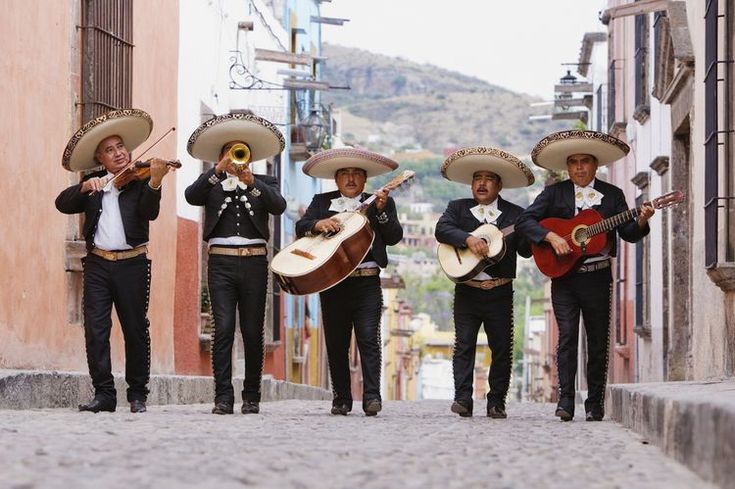
    When most people think of Mexican music, mariachi comes to mind. Originating in rural Jalisco in the 19th century, mariachi bands were originally small ensembles of violins, guitars, and the vihuela (a high-pitched guitar), later enriched by trumpets in the 20th century.

    Mariachi 1

    Mariachi is a music of celebration—serenades for lovers, patriotic hymns for Independence Day, and soundtracks for weddings and quinceañeras. The lyrics often celebrate love, land, and national identity, making mariachi one of Mexico’s strongest cultural symbols.

    Traveler’s Tip: Guadalajara, the capital of Jalisco, hosts the International Mariachi Festival each September, where top groups from around the world perform. For a more everyday experience, head to Plaza de los Mariachis, where local bands play nightly for diners and passersby.


    The North: Corridos, Norteño, and Banda

    The north of Mexico, stretching from Chihuahua to Nuevo León and beyond, offers a very different soundscape. European immigrants introduced the accordion, polkas, and waltzes in the 19th century, which blended with local traditions to form norteño and banda music.

    The corrido, a ballad that tells stories of heroes, tragedies, and social struggles, became especially popular during the Mexican Revolution. Even today, corridos narrate migration experiences, local legends, and political events. Banda, meanwhile, with its brass-heavy arrangements, provides the soundtrack to town festivals and rodeos.

    Traveler’s Tip: Monterrey is a hotspot for norteño music, with live venues ranging from dance halls to neighborhood cantinas. The Feria de San Marcos in Aguascalientes each spring is also a major showcase for regional bands.


    Oaxaca and Guerrero: Indigenous and Afro-Mexican Rhythms

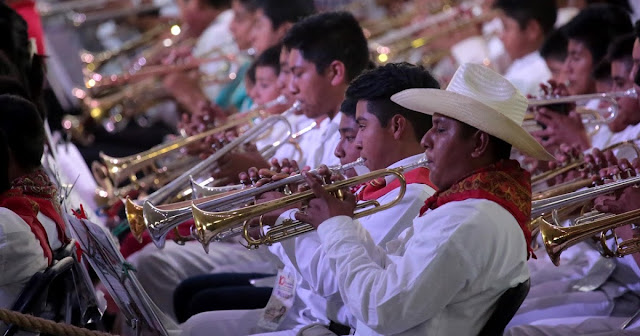
    The southern states are some of the richest regions for traditional music, where Indigenous languages and Afro-Mexican communities preserve centuries-old sounds. In Oaxaca, sones and jarabes accompany traditional dances at village festivals. In coastal Guerrero and Oaxaca, the Chilena reflects influences from South America, brought by Chilean sailors in the 19th century and infused with Afro-Mexican rhythms.

    Bandas de musica oaxaca

    The music here often accompanies communal celebrations, religious rituals, and Indigenous festivals. The Guelaguetza festival in Oaxaca every July is one of the most vibrant showcases of this musical diversity, where each Indigenous group presents its music, dances, and costumes.

    Traveler’s Tip: Plan your visit to Oaxaca in July for Guelaguetza, or explore smaller village fiestas throughout the year. These are often open to visitors and offer intimate opportunities to hear music in its traditional setting.


    Why Folk Music Matters to Travel in Mexico

    For travelers, Mexico’s folk music is not just background—it is part of the experience. The sounds you hear in a plaza, at a market, or during a fiesta carry centuries of history. Unlike staged performances, community events invite participation: clapping, dancing, or even joining in the singing.

    • Accessibility: Unlike museum exhibits, folk music is often free and public, found in plazas, markets, and festivals.
    • Cultural Insight: Lyrics and styles reflect local concerns—migration in the north, Indigenous identity in the south, or love and patriotism in central regions.
    • Living Tradition: Rather than fading, folk music continues to evolve. Young musicians blend it with rock, hip hop, or jazz, ensuring its survival and relevance.

    Planning Your Musical Journey

    • Best Festivals:
      • Festival del Son Jarocho (Veracruz, February)
      • International Mariachi Festival (Guadalajara, September)
      • Guelaguetza (Oaxaca, July)
      • Feria de San Marcos (Aguascalientes, April–May)
    • Everyday Experiences:
      • Nightly mariachi performances in Guadalajara and Mexico City’s Plaza Garibaldi.
      • Small-town fandangos in Veracruz.
      • Banda and norteño in Monterrey clubs and border towns.
      • Village fiestas in Oaxaca and Guerrero.
    • What to Listen For:
      • Strings: Jarana, vihuela, guitarrón.
      • Brass: Trumpets and tubas in banda.
      • Rhythm: Zapateado (foot-stomping) that makes the floor itself an instrument.
      • Language: Verses often improvised, humorous, or deeply political.

    Final Note
    Mexico’s folk music is not a performance staged for tourists—it is a cultural heartbeat that continues to define communities across the country. By seeking it out respectfully, travelers gain more than entertainment: they gain connection. From the fandangos of Veracruz to the brass of Sinaloa, from the violins of Jalisco to the chilenas of Guerrero, the music invites you not just to listen, but to belong.

  • James Keelaghan

    Canada’s Master Storyteller in Song

    In the landscape of Canadian folk music, few voices carry the depth of history, compassion, and craft quite like James Keelaghan. Often referred to as “Canada’s finest songwriter,” Keelaghan has built a career weaving together ballads that blend personal reflection with the sweeping arcs of historical narrative. As a true master storyteller, James Keelaghan: Master Storyteller, his songs are as much chronicles of human resilience as they are musical experiences, earning him recognition at home and abroad.

    James Keelaghan performing Kiri’s Piano.

    Early Life and Roots in Folk

    Born in Calgary, Alberta in 1959, Keelaghan grew up surrounded by the wide prairies and big skies of Western Canada. Those landscapes, along with a love for literature and history, would later shape the themes of his songwriting. He began performing in Calgary folk clubs during the 1980s, quickly gaining attention for his powerful voice and keen ability to tell stories through song. James Keelaghan, the master storyteller, truly began to emerge here.

    A Career of Craft and Care

    Keelaghan’s discography spans more than a dozen albums, each offering a thoughtful balance of original work and interpretations of folk traditions. His music often draws from historical events—such as the haunting ballad Cold Missouri Waters, which recounts a tragic wildfire, or Jenny Bryce, which evokes life in early Canadian settlements. He has cemented his place as a master storyteller.

    Beyond history, Keelaghan writes about contemporary struggles, love, migration, and the human spirit. His warm baritone voice, paired with his lyrical precision, makes his songs feel both timeless and urgent.

    Recognition and Influence

    Over the years, Keelaghan has earned Juno Awards, international festival appearances, and a devoted following across North America, Europe, and Australia. Critics and fans alike often note his unique ability to transform research and lived experience into deeply moving narratives, placing him in the company of the great folk storytellers of our time. Indeed, James Keelaghan stands as a master storyteller in modern folk music.

    He has also collaborated widely, working with artists like Oscar López in the energetic project Compadres, which blended Latin rhythms with folk storytelling. These collaborations highlight his openness to musical dialogue and cultural exchange.

    Educator and Advocate

    In addition to performing, Keelaghan has contributed significantly to the folk community as an educator and festival organizer. He served as the artistic director of the Summerfolk Music and Crafts Festival in Ontario, where he championed both established and emerging voices in folk music. His work reflects a belief in folk as a living tradition—one that evolves while honoring its roots. Such dedication enhances his legacy as a master storyteller.

    The Legacy of a Troubadour

    For more than three decades, James Keelaghan has proven that folk music can be both beautiful and meaningful, carrying with it stories that might otherwise be forgotten. Whether on a small stage or before festival crowds, he brings listeners into the heart of a tale—reminding us that songs can be vessels of memory, empathy, and shared humanity.

    Keelaghan’s career continues to inspire not only for the music itself but for the way it connects people across generations and cultures. In every verse, he upholds the enduring power of storytelling, ensuring that history sings as much as it speaks, all under the guise of James Keelaghan: master storyteller.

  • Inti-Illimani: The Eternal Voice of Chilean Memory and Resistance

    Inti-Illimani: The Eternal Voice of Chilean Memory and Resistance

    When we talk about music that transcends borders and generations, Inti-Illimani always comes to mind. More than just a musical group, they represent a cultural and political movement. This movement is rooted in the dreams, struggles, and resilience of Latin America.

    Founded in 1967 by university students in Santiago, Chile, Inti-Illimani became one of the leading voices of the Nueva Canción Chilena (New Chilean Song) movement. This artistic wave sought to recover and modernize traditional Andean music. It blended indigenous instruments and melodies with lyrics about justice, love, and social change. With instruments like the charango, quena, zampoña, and guitar, Inti-Illimani created a sound unmistakably their own. It was simultaneously rooted in the past and reaching toward a better future.

    Their name carries symbolic weight: “Inti” means sun in Quechua, while “Illimani” is the name of a snow-capped mountain in Bolivia’s Andes. Together, the words evoke the timeless bond between nature, culture, and human dignity.

    But history gave Inti-Illimani a role far larger than music. On September 11, 1973 (on what has been termed The First 9/11) while the band was on tour in Europe, Chile suffered the military coup that toppled the democratically elected President Salvador Allende. Unable to return to their homeland under Augusto Pinochet’s dictatorship, Inti-Illimani lived in exile in Italy for more than 15 years. Instead of silencing their voices, this forced displacement amplified them. Their concerts became gatherings of solidarity. Their albums served as a reminder to the world of Chile’s suffering and hope. They transformed grief into harmony, exile into connection.

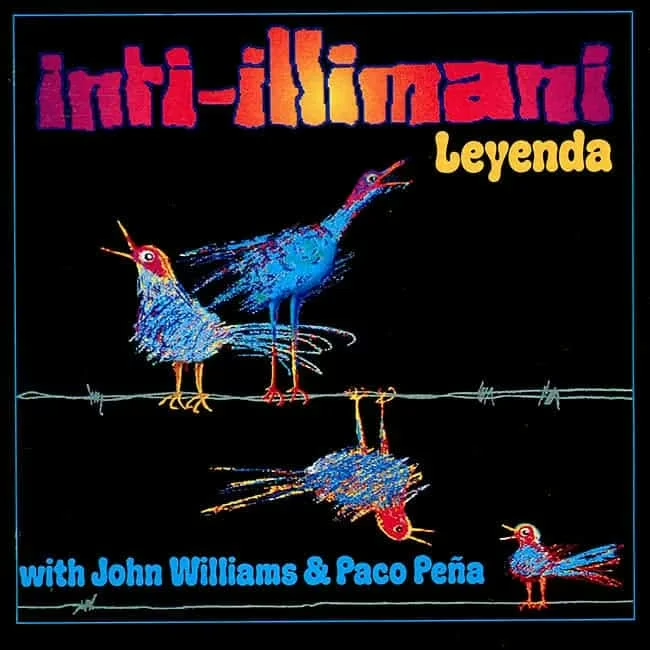
    Inti·illimani john williams paco pena leyenda 1990

    Over the decades, Inti-Illimani’s discography has woven together songs of resistance, folklore, and poetry. Classics like El pueblo unido jamás será vencido became anthems of global protest. They were sung far beyond Chile’s borders. Their music inspired not only Latin American movements but also international audiences. These audiences recognized in their songs a universal longing for freedom.

    Today, the legacy of Inti-Illimani remains vibrant. Despite lineup changes and the passing of years, the group continues to perform. They adapt to new times while staying true to their essence. Their music has become part of the collective memory of Chile and the broader Latin American diaspora. It stands as a living testimony that art can endure dictatorship, exile, and generations of change.

    At its heart, Inti-Illimani is not only about music—it is about identity, struggle, and the ability of song to heal and unite. They remind us that every note can carry a story. Additionally, every story can echo across mountains, borders, and time itself.

    Maya Riviera Condos

  • Folk Music – Huajra

    In this site we published a video with a song titled Huajra. This piece is a wonderful example of traditional songs from Latin America, selected to reflect the beauty of Latin American music. Created by Atahualpa Yupanqui, the theme reflects the dry corn harvest in Yupanqui’s Argentina. Atahualpa traveled extensively by horse (or mule) through the mountains of Argentina and this solitude is what he recognized as the trigger for this capacity to create poetry and to speak of the simple life of Argentinians.

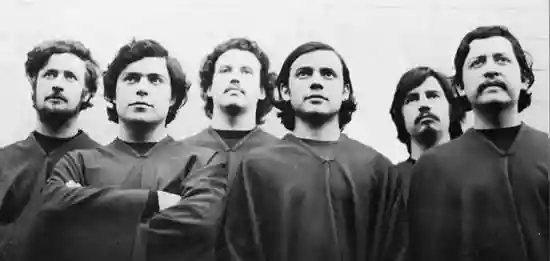
    Inti illimani
    Italian Formation

    The Chilean group Inti-Illimani (Mountain of the Sun) arranged Huajra and added Charangos (the Indian guitar), and quenas (Indian flute) in addition to percussion instruments. This traditional folk song has been performed in scenarios across the globe and showcases the integration of music from different parts of the Americas, performed by master musicians. Inti-Illimani’s convergence with other musical traditions (such as Italian folk music) is recognized world-wide in songs such as “La Tarentelle” and “El Mercado de Testaccio

    I hope you enjoy this song and don’t forget to click on other compositions by these masters of the Latin American traditional folk songs.

    Maya Riviera Condos

Maya Riviera Condosx
Chatbot